 How-to
How to Choose the Right Paint Sheen for Every Room
Table of Contents
- Why Paint Sheen Matters More Than You Think
- Paint Sheen Chart: Comparing Finish Levels by Shine
- Eggshell vs. Satin Paint: Which One Belongs in Your Home?
- Best Paint Sheen for Bathrooms, Kitchens, and High-Moisture Areas
- Paint Sheen for Trim and Doors: Getting the Details Right
- How Lighting, Color, and Surface Prep Change Perceived Sheen
- Your Step-by-Step Process for Choosing and Testing a Finish
- Conclusion
- Frequently Asked Questions
Last Updated: October 6, 2026
Why Paint Sheen Matters More Than You Think
Paint sheen is the amount of light a dried paint film reflects, and it decides how washable, durable, and forgiving that finish will be. At Southern Perfection Painting Inc., we have finished homes and commercial spaces across metro Atlanta.
Sheen is a trade-off, not a ranking: more shine means easier cleaning and better moisture resistance but more visible texture; less shine hides flaws but scuffs faster.
The real question is which sheen fits this room, surface, and lighting. Below, we break down every finish level and a testing process you can run before you buy a gallon.
Paint Sheen Chart: Comparing Finish Levels by Shine
The Paint Quality Institute guide to paint finishes groups interior finishes by their light reflection, from flat to high-gloss. Here is how the five common levels compare.
| Finish | Shine Level | Durability | Best For | Main Trade-Off |
|---|---|---|---|---|
| Flat / Matte | None to very low | Low | Ceilings, low-traffic bedrooms | Hard to clean |
| Eggshell | Low, soft glow | Medium | Living rooms, dining rooms | Shows some marks |
| Satin | Moderate shine | High | Hallways, kids' rooms | Highlights wall texture |
| Semi-Gloss | Noticeable shine | Very high | Kitchens, bathrooms, trim | Shows every bump |
| High-Gloss | Mirror-like | Highest | Doors, cabinets, accents | Unforgiving surface |
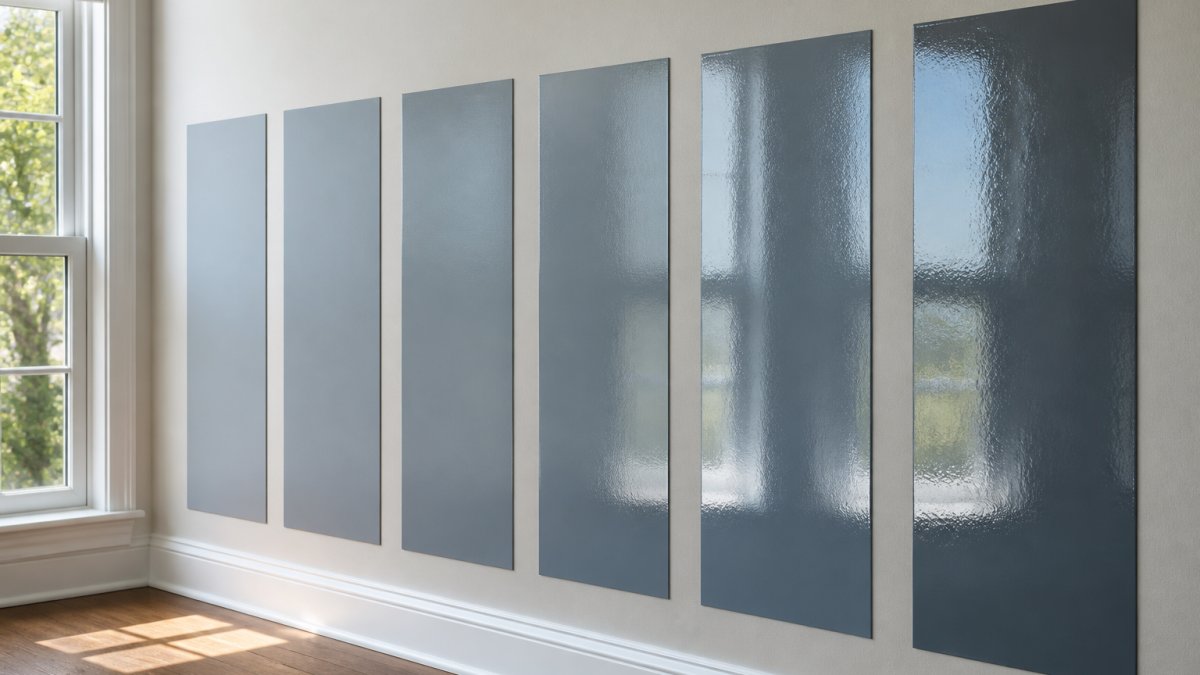
Flat and Matte Finishes
Flat and matte finishes absorb light instead of bouncing it back, hiding surface imperfections better than any other option. That soft look suits ceilings, formal living rooms, and low-traffic bedrooms. The catch: flat paint scuffs easily and does not stand up to scrubbing, so keep it out of hallways and kids' spaces.
Eggshell and Satin Finishes
Eggshell finish has a low, soft glow and balances stain resistance with a gentle look, making it the most common choice for living spaces. Satin finish carries a moderate shine and a harder film, making it the better pick for high-traffic areas and family homes.
Semi-Gloss and High-Gloss Finishes
Semi-gloss finish reflects noticeable light and forms a tough, moisture-resistant surface for kitchens, bathrooms, and trim. High-gloss finish is the shiniest option, with a mirror-like surface that resists stains best of all. Use it on doors, cabinets, and accents for a bold, durable look.
Eggshell vs. Satin Paint: Which One Belongs in Your Home?
Eggshell is the better choice for living rooms and bedrooms, while satin wins in hallways, kitchens, and kids' rooms. Eggshell's low glow hides wall texture and small dents; satin's moderate shine reflects more light, making bumps more visible. A poorly prepped wall looks worse in satin than in eggshell.
Best Paint Sheen for Bathrooms, Kitchens, and High-Moisture Areas
Semi-gloss is the best paint sheen for bathrooms and kitchens because it resists moisture and wipes clean without dulling. Steam, splashes, and cooking grease all attack paint films, and a shinier finish holds up better against all three.
For these rooms, we recommend:
- Bathroom walls: satin or semi-gloss
- Bathroom ceilings: satin, to resist steam
- Kitchen walls: semi-gloss for easy degreasing
One warning: semi-gloss on a large, poorly prepped wall shows every flaw. If your walls have patches or uneven texture, step down to satin and spend the saved effort on prep.
Paint Sheen for Trim and Doors: Getting the Details Right
Semi-gloss is the standard for trim and doors, with high-gloss as the upgrade for a sharper look. Trim takes more contact than walls, hands, furniture, vacuum bumps, and shoes, so a harder, shinier film stands up to that wear and wipes clean. The right sheen also depends on the trim material and product line.
Match the sheen to the substrate
The substrate changes how a sheen reads and holds up:
- Solid wood trim and doors: Semi-gloss is the workhorse. Wood grain telegraphs through high-gloss, so a mirror finish needs filling and sanding first.
- MDF and engineered trim: Smooth and non-porous, so high-gloss lays down flatter than on wood. Prime cut edges or the sheen will look blotchy.
- Vinyl and composite exterior trim: Factory-finished; usually only need a satin or semi-gloss topcoat for color refresh. High-gloss can look plasticky on composite.
Enamel vs. latex: the sheen is only half the story
Homeowners often pick a sheen and ignore the resin. Trim paints come in two families:
- Waterborne (acrylic) enamels, the modern default: low odor, fast recoat, good leveling, and they hold up on interior trim for years with normal wear.
- Oil-based and alkyd enamels, harder film, better flow-out, and a gloss that stays glossier longer. Trade-offs: odor, longer dry time, and yellowing on white trim.
For a true high-gloss look on cabinets or doors, an alkyd or waterborne alkyd hybrid usually delivers a smoother, more durable film than standard acrylic. Check the product data sheet, sheen names like "semi-gloss" are not standardized, and one brand's semi-gloss can read closer to another brand's satin.
Trim sheen picks by element
- Baseboards: Semi-gloss for durability and easy scuff wiping.
- Door and window casings: Semi-gloss; high-gloss to make trim a design feature.
- Interior doors: Semi-gloss for daily use; high-gloss for a lacquered, furniture-like finish.
The contrast rule
Trim one step shinier than the walls reads as intentional; two or three steps shinier can look dated, especially with modern flat or matte walls. Pairings that age well: eggshell walls with semi-gloss trim, or matte walls with satin trim.
How Lighting, Color, and Surface Prep Change Perceived Sheen
Perceived sheen shifts with lighting, color, and prep, even when the paint is identical. A satin wall under a bright window can look like semi-gloss; the same satin under soft lamplight looks closer to eggshell. Most guides tell you what each finish is, not why the same finish looks different in your house.
The mechanism: specular vs. diffuse reflection
Every paint film reflects light two ways. Specular reflection bounces light off the surface at a mirror angle, the shine you see. Diffuse reflection scatters light in all directions, the color you see. Flat paint is almost all diffuse; high-gloss is heavily specular. Change the angle or intensity of light hitting the wall and you change how much specular reflection reaches your eye, which is why the same paint can look flat in one room and shiny in another.
Lighting direction and temperature
- Angled light exaggerates sheen. A lamp, sconce, or under-cabinet light aimed across a wall turns every bit of texture into a highlight, so semi-gloss looks worse under angled light than under a ceiling fixture.
- Overhead light flattens sheen. A single ceiling fixture washes the wall evenly and hides both gloss and texture, the most forgiving, least representative condition.
- Natural light is the harshest test. Daylight comes in at a low angle for much of the day and reveals everything. If a sheen looks good in daylight, it will look good under artificial light.
- Color temperature matters. Warm bulbs (around 2700K) soften gloss; cool bulbs (around 4000K and up) make it read sharper. The same satin wall can feel warm or clinical depending on the bulb.
Color depth changes perceived sheen
Deep and dark colors show gloss more than light pastels, because a glossy highlight on a dark surface is a bright reflection against a dark field. On a white or pastel wall, the highlight blends into the base color and the sheen reads softer. If you want a dark wall to look matte, choose a lower sheen than you would for the same color in white: a dark satin often reads like a semi-gloss, and a dark eggshell like a satin.
Surface prep decides how even the sheen looks
Sanding, patching, and priming decide how smooth the film dries. A rough wall makes any sheen look uneven because specular reflection catches every ridge. Three prep failures that ruin sheen:
- Un-sanded drywall compound, the fuzzy edge of a patch grabs light differently than the surrounding wall.
- Insufficient primer, bare drywall and patched areas absorb paint at different rates, so the film dries at different thicknesses and reflects differently.
- Roller nap mismatch, a thick nap on one wall and a thin nap on the next leaves a texture difference that reads as a sheen difference even with the same paint.
A testing protocol that actually predicts the result
The American Coatings Association overview of paint formulation notes that resin and pigment levels vary by product line, so two "satin" paints from different brands can reflect light differently. Always check the actual product, not just the label. To test perceived sheen in your own space:
- Paint two coats on foam boards or stir sticks in the actual color and sheen you are considering.
- Let them cure at least 24 hours, wet and cured paint reflect differently.
- View the boards in the morning, at midday, and after dark with the room's lights on.
- Tilt each board at a low angle to simulate angled light, then look straight on.
- Compare the boards against the actual wall, its existing texture is part of the equation.
Your Step-by-Step Process for Choosing and Testing a Finish
Follow this process to choose right paint sheen for any room without guessing.
Total time: 1-2 hours Difficulty: Beginner
What you'll need:
- Paint stir sticks or foam boards
- Small samples of your top two sheens
- Painter's tape
Step 1: Match the room to a sheen range [15 minutes] List each room's traffic and moisture level.
Step 5: Test cleanability [10 minutes] Once dry, scuff each sample with a damp cloth.
Expected result: You will know exactly which sheen looks right and cleans right before you commit.
Conclusion
Choosing the wrong sheen means living with a wall that shows every mark, or one you cannot wipe down. The fix: match the finish to the room, then test it before you commit.
At Southern Perfection Painting Inc., we handle that whole process for you. Our trained W-2 crews use premium paints from Sherwin-Williams and Benjamin Moore, deliver a detailed itemized quote within 48 hours, and back every project with a written workmanship warranty.
Frequently Asked Questions
Which paint finish is better, eggshell or matte?
Neither is universally better; the right choice depends on the room. Matte finishes hide wall imperfections and give a soft, non-reflective look, making them ideal for low-traffic areas like bedrooms and ceilings. Eggshell offers slightly more shine and better stain resistance, so it works well in hallways, living rooms, and family spaces. If you need easy cleaning without too much gloss, eggshell is the practical pick. For ceilings and formal spaces where appearance matters most, matte is the better option.
What are the key differences between eggshell and semi-gloss paint?
Eggshell has a low-luster finish that reflects a small amount of light, while semi-gloss is noticeably shinier and more reflective. Semi-gloss is more durable and easier to scrub, which is why it is commonly used on trim, doors, cabinets, and in bathrooms or kitchens. Eggshell provides moderate washability and a softer look that works well on large wall surfaces. If you want a balance of cleanability and appearance, eggshell is a solid choice for walls; semi-gloss is better for surfaces that take frequent handling or moisture.
Which paint sheen is easiest to clean?
Gloss and semi-gloss finishes are the easiest to clean because their smooth, non-porous surface resists stains and allows scrubbing without damaging the paint film. Satin is a close second and is often recommended for high-traffic areas where washability matters. Flat and matte finishes are the hardest to clean because their porous surface traps dirt and does not tolerate scrubbing well. For kitchens, bathrooms, and kids' rooms, choose satin or semi-gloss to make maintenance simpler.
Does paint sheen make wall imperfections more noticeable?
Yes. The shinier the finish, the more it reflects light and the more it highlights bumps, cracks, and uneven wall texture. Flat and matte finishes absorb light and hide surface imperfections well, which is why they are often used on ceilings and older walls. Semi-gloss and gloss finishes magnify flaws, so they are best reserved for smooth, well-prepped surfaces like trim and doors. If your walls have texture or patching, stick with flat or eggshell to minimize visible flaws.